Rich Text
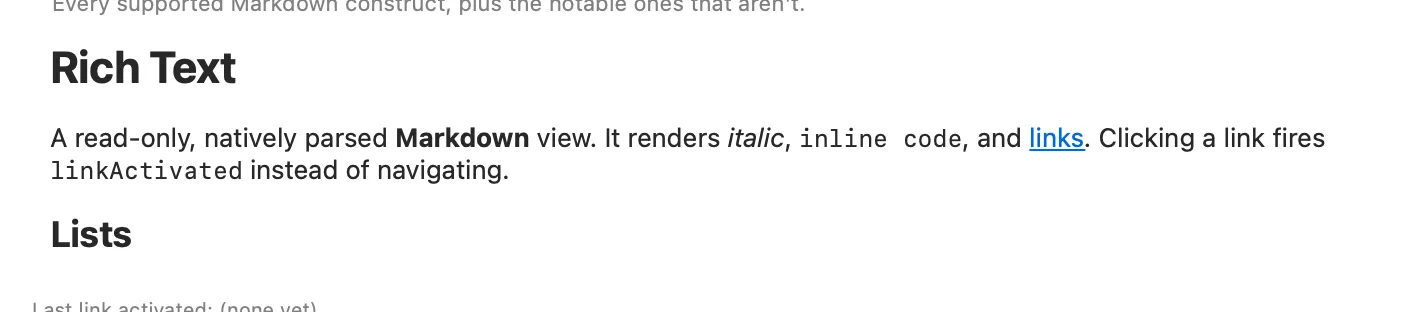
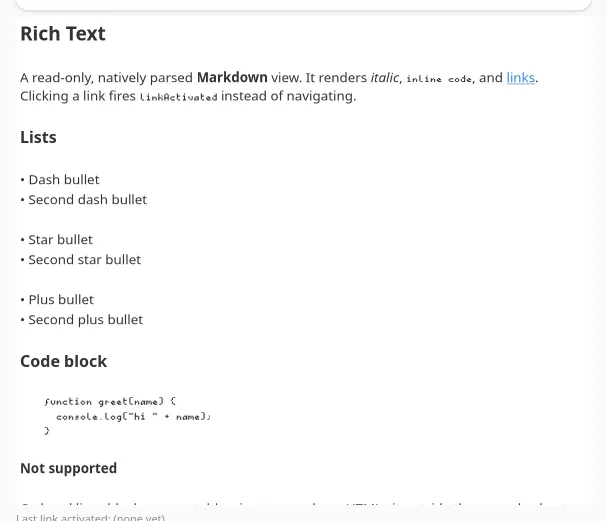
<richtext> parses a constrained Markdown subset and renders it with each platform’s own text
system, not a web view: an NSTextView fed a parsed NSAttributedString on macOS, a native text
widget on GTK.
const markdown = `# Release Notes
**v0.2** adds *dark mode* and a \`--strict\` flag. See[the changelog](https://example.com/changelog) for details.
- Faster startup- Fixed a crash on quit
\`\`\`nd build --strict\`\`\``;
<richtext markdown={markdown} onLinkActivated={(e) => openExternal(e.text)} />;| Prop | Type | Applied | Notes |
|---|---|---|---|
markdown |
string | createAndUpdate | The source text, re-parsed on every change. |
selectable |
bool | createAndUpdate | Whether the rendered text can be selected and copied. Default true. |
| Event | Handler | Payload |
|---|---|---|
linkActivated |
onLinkActivated |
text, the link’s href |
Clicking a link never navigates the view; it fires linkActivated and leaves handling up to you.
Pair it with openExternal from
@nativedesktop/react to open it in the OS default browser.
Supported subset
Section titled “Supported subset”ATX headings (# through ######), paragraphs, bullet lists (-, *, or + markers), fenced code
blocks, **bold**, *italic*, `inline code`, and [label](href) links.
Not supported: ordered lists, block quotes, tables, images, and raw HTML. Content using them renders as plain text rather than erroring.
See examples/parity/main.tsx’s Rich Text section for every construct rendered at once.